It’s impossible to talk about Babylon (2022) without bringing up its extreme vulgarity. The film actually starts and ends with an ‘asshole.’ If you’re thinking, “What do you mean?”—yes, that’s really how it ends. Right from the start, it throws shock value at the audience and seems to say, “Don’t take this too seriously.”
The opening is both shocking and, in its own way, boldly refreshing. From here, it’s evident that the film chooses to mock the silent film era rather than honour it.

Director Chazelle has said in interviews that he read many film history books, but the movie doesn’t really show accurate period details. The characters don’t look like they’re from that time, and the silent films in the movie look like simple black-and-white clips.
The Golden Duo of Director Chazelle and Harwitz
One of the film’s biggest strengths is Justin Hurwitz’s score. Having worked with Chazelle since their student days, Hurwitz brings the movie to life with his music.
The “Voodoo Mama” theme, which plays from the opening party scene, is a catchy blues tune that keeps the audience engaged. It gives the film an energetic, festival-like atmosphere and adds to the movie’s fast pace and tension. Thanks to this score, the three-hour runtime feels much shorter, similar to the experience of watching Scorsese’s The Wolf of Wall Street or Goodfellas.
The magic of Hollywood is symbolised by the motif of “holes.”
Besides the music, another standout feature is the recurring “holes” motif that Chazelle uses throughout the film. From camera lenses and trumpet openings to the two butt holes at the start and end, the camera work often gives the feeling of being pulled into these circles.
The scenes where the camera is drawn into Sidney’s trumpet are especially memorable. The empty circle shows both the emptiness of fame and the strong pull of Hollywood’s magic.
It is “sucked into a hole” imagery, along with quick camera movements similar to those in La La Land and Chazelle’s early film Guy & Matilda’s Dance, that are key visual styles for the director. This technique draws viewers into Hollywood’s dream world and adds to the film’s energy.
The Birth of an Era’s Goddess and Star
Margot Robbie as the Embodiment of an Era’s Goddess
Nelly, played by Margot Robbie, is the central figure in the film. Her character is a mix of several silent-era actresses. Although the pamphlet mentions Clara Bow as her inspiration, interviews with the director show that Nelly was based on a combination of real actresses, including Alma Rubens and Jean Eagles.
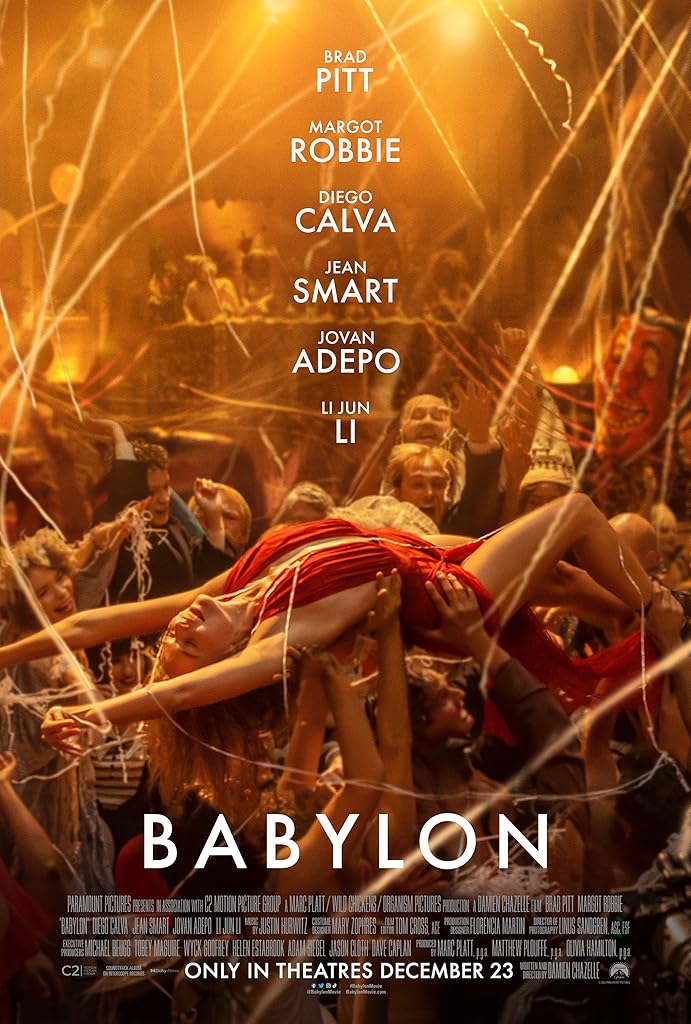
Margot Robbie stands out with her energetic dancing and gives a performance that really lives up to the phrase “never a dull moment.” Without her, the three-hour film would have felt much longer. It’s fair to say that both Justin Hurwitz’s music and Robbie’s presence keep the movie moving.
This role, much like her part in Once Upon a Time in Hollywood, is iconic. As the goddess of the era, Margot Robbie’s dancing at the heart of the Babylon festival is the film’s brightest spot in an otherwise chaotic world.
The Birth of a New Star: Diego Calva
One of the film’s biggest successes is making Diego Calva a star. His performance as Manny, especially in the final scene, is very moving.
There’s a decisive moment when Manny, who came to Hollywood chasing his dreams, gives up his real name, hides his Mexican roots by pretending to be Spanish, and loses his sense of self. When he finally realises he’s become part of something larger, his expression—a mix of happiness and sadness—captures the film’s main message.
Love-Hate Relationship with Film History — A Dangerous Tightrope Walk Between Respect and Mockery
Babylon (2021) openly draws inspiration from many classic films. The closest comparison is Paul Thomas Anderson’s Boogie Nights. While the settings are different, both movies use an ensemble cast to show the ups and downs of their characters. The final sequence, in which a character enters the “asshole,” is almost identical to a scene in Boogie Nights, underscoring how much this film borrows from it.
Director Chazelle has publicly cited five films as references: the 1929 short film Black and Tan, D.W. Griffith’s Intolerance, Marcel Carné’s Les Hommes de la 3e rangée, Fellini’s La Dolce Vita, and Scorsese’s early work Mean Streets.
The similarities to La Dolce Vita stand out. In both films, the main character arrives from the countryside and becomes more corrupt as he gets involved with the upper class, just like Manny does here. Both movies also move physically from high to low, starting with a party on a hill and ending deep underground. In the final LA scene, Toby Maguire’s character is led down to lower levels with the line “Lower, lower.”
From Mean Streets comes the dynamic between Manny and Nelly. The protagonist worries about his friend accumulating debt, yet the friend repeatedly betrays him.
A Problematic Approach to the Silent Film Era
However, the most problematic aspect of this film is its simplicity. The biggest issue with this film is how it shows silent film sets as outdated and straightforward. In reality, film history books like Kevin Brownlow’s The Golden Age of Silent Film show that the techniques used back then were actually very advanced. Some even say they were better than today’s methods. In this book, the film unfolds comedic sequences that mock the shooting set. It exaggerates the silent-film shoot for comedy, portraying it as barbaric, almost primitive.
The early scene where Manny and Nelly visit different film sets was my favourite because of its fast pace. However, it’s also where the film’s mockery of silent movies is most apparent. This style is similar to the lowbrow humour in the Anchorman series, and compared to last year’s The Monster’s Last Stand, the lack of respect for silent film is clear.
The Dramatic Tone Shift Midway
The film starts as a black comedy but turns tragic about halfway through, after Jack’s best friend dies. What was once played for laughs suddenly becomes serious, as the story treats death with much more somberness.
The relationship between Manny and Nelly is similar to the story in Mean Streets. Manny keeps trying to help the wild and free-spirited Nelly, but she always lets him down.

By the end, many viewers will find Nelly frustrating, but the film shows that she can never get back her former glory. It is similar to the ending of Mia and Seb in La La Land, fitting into Chazelle’s pattern of telling stories about “star-crossed lovers.”
The ironic reality revealed by its box office failure.
The film had a budget of about $80 million but grossed only about $50 million worldwide, making it a box-office flop. In a way, the movie’s own failure matches its theme.
Like D.W. Griffith, who built the city of Babylon in Intolerance and faced a box office failure, Chazelle made his own modern “Babylon” and met the same result. It’s unusual for a film’s theme and real-life outcome to match so closely.
Summary: Finding the essence of love for cinema amid filth
Babylon is definitely a controversial film. It’s vulgar, messy, and has scenes that could upset silent film fans. Still, it’s rare to find a movie that makes you think so much about film culture.
Chazelle’s usual theme—that dreams require sacrifice—is strong in this film too. The characters who give everything for their art continue the ideas he explored in Whiplash and La La Land.
The real appeal of the film lies beneath its messy, vulgar surface—a deep love for cinema. As a tribute to dreamers and film culture, this chaotic movie is hard to forget.
I don’t recommend watching this movie while eating, but if you want to think about what cinema really is, you should see it at least once.