About the Original “The Tale of the Bamboo Cutter”
“The Tale of the Bamboo Cutter,” the origin of “Super Princess Kaguya!,” is one of Japan’s oldest tales, dating back to the early Heian period (around the 9th to 10th centuries). Its author is unknown, and it has been passed down for over a thousand years as the story of “Princess Kaguya,” familiar to every Japanese person.
The general outline of the story is as follows.
- An old man, the Bamboo Cutter, finds a glowing bamboo stalk in a bamboo grove. Inside, he discovers a tiny girl and raises her as his own child.
- She grows into a woman of extraordinary beauty, Princess Kaguya. Hearing of her fame, five noblemen came one after another to propose marriage.
- Princess Kaguya presents each with an impossible task—demanding they bring her an unattainable treasure—and rejects them all.
- The Emperor of the time also fell for her, but Kaguya wept whenever she saw the moon, eventually revealing her true nature.
- She was an inhabitant of the Moon Kingdom, and one day, her people would come to take her back. Then, on the night of the full moon during the fifteenth night of the lunar month, celestial beings clad in heavenly robes came to fetch her. Kaguya returned to the moon, stripped of her earthly memories and emotions.
Shingo Yamashita, director of the Jujutsu Kaisen OP, makes his feature directorial debut.
Shingo Yamashita, director of the Netflix anime film “The Princess Kaguya!” and CEO of Studio Chromato, is renowned for his direction, animation, 3D, and cinematography. His emotionally evocative visuals and comprehensive scene creation have gained attention within the industry and beyond.
His name became widely known through his participation in the TV anime “NARUTO Shippuden.” His overwhelming presence in the opening and ending sequences drew intense attention from video enthusiasts on platforms like Niconico Douga. In 2020, he made his directorial debut with the original Pokémon Sword & Shield anime “Wings of Twilight,” where his emotionally rich visuals and intimate storytelling approach were highly acclaimed.
The decisive turning point came with the opening animation for the first season of the TV anime “Jujutsu Kaisen.” This was realized after the original author, Gege Akutami, personally informed the production team that he was a fan of Seigo Yamashita. He subsequently handled the opening animation direction for “Chainsaw Man” (OP: Kenshi Yonezu “KICK BACK”) and “Urusei Yatsura,” cementing his name among anime fans worldwide.
The main works I’ve participated in are summarized as follows.
| Year | Work | Role |
|---|---|---|
| 2012〜2013 | NARUTO -Shippuden | OP/ED Storyboard Artist, Director, Animation Director |
| 2020〜2021 | Jujutsu Kaisen Season 1 | OP Animation Director |
| 2022 | Chainsaw Man | OP Storyboard/Direction/3DCG/Cinematography Director |
| 2022〜 | Urusei Yatsura | OP Direction |
| 2026 | Cosmic Princess Kaguya! | First Feature Film Director |
Director Yamashita has stated in various interviews that he is the type of creator who “first visualizes the scene and the characters’ emotions, then translates that into words and storyboards,” valuing the inherent “physiological pleasure” of animation. He is also known for his unique workflow, such as introducing the “color script” technique used in Pixar productions to Japanese animation, enabling him to maintain a consistent visual image throughout the production process.
This film marks Shingo Yamashita’s feature directorial debut, where he immediately took on the challenge of a 2-hour-and-22-minute epic. Given that all the techniques he honed through his work on short films, promotional videos, and opening sequences are condensed into a single movie, its high density is entirely understandable.
Virtual Space × Full-Throttle Entertainment: Its Lineage and the Position of Super Princess Kaguya!
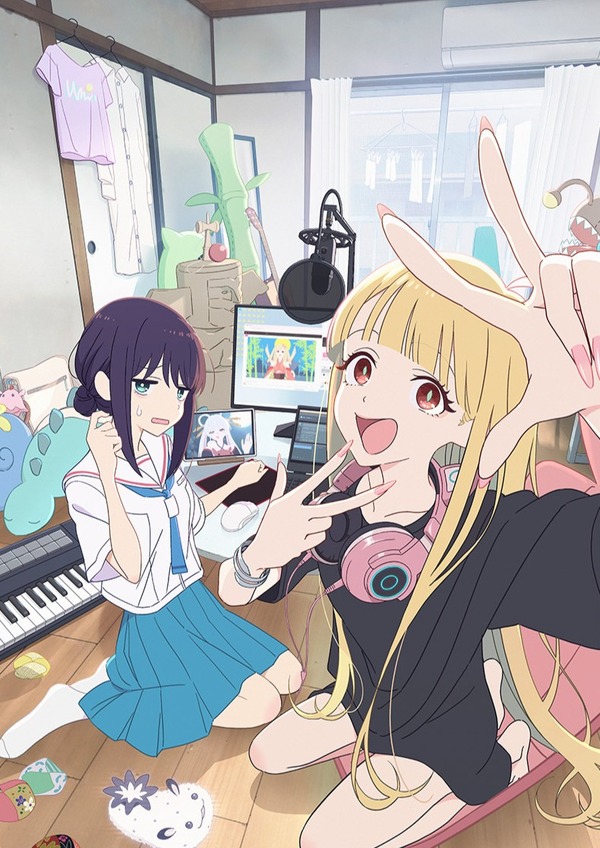
If we had to describe the anime film Super Princess Kaguya! in one phrase, it would be “a film that goes all out with entertainment set in a virtual space.” The viewing experience, where the meticulously drawn animation in the high school daily life, battle action, and live performance scenes unfold at a high tempo, resonates with previous works also set in virtual spaces.
The Intensity of Hand-Drawn Live Scenes
One of the film’s biggest highlights is the live performance segment in the virtual space Tsukuyomi. The visuals, featuring dance and vocals intertwined without relying on CG compositing, possess a power and emotional impact that transcends mere “anime live performance direction.” Combined with its mix of laughter and tears, the live scene within the film stands as its core moment
Battle Action Density
Another highlight is the territory-grabbing battle scenes unfolding within the virtual space. Weapon designs like hammers with boosters, featuring gimmicks that enhance both movement and destructive power, deliver visually exhilarating action sequences showcasing brilliant composition. While many scenes are depicted in digest format, the density within each individual shot is exceptionally high. Even extracted on their own, these sequences stand as fully satisfying animations.
Related Works Viewed Through the Lens of Virtual Space × Entertainment
Works that fuse the theme “Only in the virtual space can you be your true self” with overwhelming entertainment experiences have produced several masterpieces in recent years. Viewing the following works alongside it makes clear what unique character the anime film ‘The Princess Kaguya!’ possesses within this lineage.
Steven Spielberg’s ‘Ready Player One’ (2018)
One of the live-action films closest to ‘The Princess Kaguya!’ in worldview. It depicts a society in which people live as avatars in the vast virtual space “Oasis,” linked to the real world. The theme of truly expressing oneself only in the virtual realm, the battles and live performances within the virtual space, and the contrast with the real world—this visual experience, built with full force as entertainment, shared many common elements with ‘The Super Princess Kaguya!’. However, this work focused primarily on action and battles and lacked live music scenes.

There was no weird world-saving stuff, so it kept me excited and entertained. It was great for movie, manga, and anime fans (quite a few Japanese subcultures were depicted as Japanese subcultures). I was very excited and enjoyed the whole time.
Director Mamoru Hosoda’s ‘The Girl Who Leapt Through Time’ (2021)
Its structure—a story of a girl balancing music activities in the virtual space “U” with her real life—makes it extremely similar to ‘The Princess Kaguya!’. The emotions are truly liberated only when singing as an avatar; the gap between the virtual and real selves—these two films share a similar worldview, yet their direction and choice of ending are contrasting. Comparing their different approaches to entertainment really highlights each director’s distinct personality.
An Ode to the NicoNico Generation: Vocaloid Tracks Color the Virtual Space of the Reiwa Era
The following six Vocaloid producers appear:
- Ryo (supercell)—A figure who shaped Hatsune Miku culture with “Melt” and “World Is Mine”. For this work, he provided the newly written main theme “Ex-Otogibanashi” and “World Is Mine CPK! Remix”.
- KZ (livetune)—A globally recognized pioneer of electro-pop, known for “Tell Your World.”
- 40mP—A representative producer of the 2010s Nico Nico Douga era, known for “Torinoko City” and “Karakuri Pierrot.”
- HoneyWorks—A creator unit with over 2.5 billion cumulative views, known for “Taketori Overnight Sensation.”
- Aqu3ra——Also provided music for ‘Project Sekai Colorful Stage! feat. Hatsune Miku is gaining attention as a new-generation Vocaloid producer, known for transparent soundscapes.
- yuigot——A composer acclaimed for delicate scene depictions in works like ”Yume wo Miru Shima.“

When characters in the film sing classics like “World Is Mine,” “Torinoko City,” “Taketori Overnight Sensation,” and “Happy Synthesizer,” longtime Vocaloid fans feel a wave of nostalgia. These songs bring back memories of that era, while the film’s modern visuals add a new element.
And if your heart definitely warmed upon hearing these song titles, you are undoubtedly this film’s core target audience. The theme that one can only truly be oneself in the virtual world embodies the very worldview of NicoNico Douga, born from anonymous culture and avatars. The film’s overall tone felt imbued with nostalgia for the era when Vocaloid was born, and NicoNico Douga flourished. The structure in which Princess Kaguya, unable to live authentically, overlaps with the modern loneliness of being able to express one’s true self only virtually struck me as a sincere thematic core.
Official Release Video
【Official MV】World Is Mine CPK! Remix (Kaguya & Tsukimi Yachiyo ver.) – ryo (supercell) / from Super Princess Kaguya!
【Cover】Lonely Universe – Aqu3ra / covered by Yachiyo Tsukimi (voiced by Saori Hayami) from Super Princess Kaguya!
【Cover】Torinoko City – 40mP / covered by Yachiyo Tsukimi (voiced by Saori Hayami) from Super Princess Kaguya!
【Cover】Dreaming Island – yuigot / covered by Kaguya (voiced by Yuko Natsuyoshi) from Super Princess Kaguya!
【Cover】Tell Your World – kz / covered by Tsukimi Yachiyo (voiced by Saori Hayami) from Super Princess Kaguya!
Director Yamashita decided to bring together legendary Vocaloid producers like supercell’s ryo when he envisioned Tsukimi Yachiyo, the virtual space administrator, as a “being without a physical form who watches over people and sings.” Her image naturally overlapped with Hatsune Miku’s iconic symbolism. This wasn’t merely a trendy casting choice; the Vocaloid producers’ music was an essential piece woven into the story he wanted to tell. The miraculous fit with the ending theme “ray” is proof of this consistency. “I want to surprise those who think it’s a shallow project with its substance,” says the director. Experience the impact of this new-era music anime, built upon a solid narrative, with your own ears.

The second viewing makes you cry more than the first. Kaguya knew from the start.
The story’s core axis is “Kaguya creating her own happy ending.” The premise—“a Kaguya who knows she’s destined for a bad ending, yet resists it”—is a very clear thematic focus. The story delves into its two protagonists, “Iroha, who falls in love through actions,” and “Kaguya, who falls in love through her very existence,” each portrayed in distinct ways. Iroha draws empathy through her past and inner conflicts, while Kaguya captivates viewers with her overwhelming freedom and purity. The moment these two stories vividly intersect through the live performance scene represents the emotional climax of the animated film ‘Super Princess Kaguya!’.
Many viewers report that upon a second viewing, the lyrics effortlessly sink in, and the characters’ expressions take on new meaning—clear evidence of the film’s skillful embedding of foreshadowing and emotional expression. The structure, in which “characters were actually known to us in early scenes,” is woven throughout, transforming the second viewing into a film distinct from the first.
Enthusiastic Fans and Some Reviewers: An Evaluation Structure Mirroring the Super Mario Phenomenon
Conversely, some reviewers and viewers prioritizing narrative consistency have offered harsh critiques. Criticisms like “the story is thin,” “the characters suddenly become close,” and “there’s no foundation for emotional investment” carry some weight. Given the structure, which prioritizes visuals and live-action spectacle over narrative, the gradual buildup of psychological shifts feels somewhat abbreviated.
This split in opinion is similar to what happened with the 2023 film “The Super Mario Bros. Movie.” Critics said it “lacked narrative depth,” but gamers and families loved it, and it made over $1.3 billion worldwide. Both films focus on entertaining a specific generation and culture, using strong characters and visuals instead of deep stories. To some, they seem shallow, but to fans, they are masterpieces.
Summary: The voices of that era return to the virtual space of Reiwa
Netflix Original Anime ‘Ultra Princess!’ is an animated film that races through its 2 hours and 22 minutes with such intensity that it feels like “a flash.” It condenses the content of a full anime season, and the latter half does indeed feel rushed. This is because it pours all its energy into moving the audience through visuals, music, and character presence, rather than through intricate storytelling or meticulous psychological portrayal. While this “all-out entertainment” approach invites criticism, it’s also the source of its strength, making viewers exclaim, “This is exactly what I wanted to see!”
For anyone who grew up with Vocaloid songs on NicoNico Douga and remembers when Hatsune Miku first appeared, this film is a special trip down memory lane. Now that VTubers, fan communities, and streaming are everywhere, it feels especially meaningful that Seigo Yamashita released this movie at this time.