


If I had to sum up “Mobile Suit Gundam: Hathaway’s Flash – The Sorcery of Nymph Circe” in one phrase, I’d call it a dark ‘Top Gun: Maverick’ led by a troubled young pilot.
The climactic aerial battle between the protagonist Hathaway’s Ξ (Kushi) Gundam and the Federation’s Lane Aim, piloting the Aluzeus (a prototype using a mass-produced Nu Gundam as its core), vividly evokes the dogfights of ‘Top Gun’. The first-person cockpit view, the warning beeps of missile lock-ons, and the tension as flares and missiles fly everywhere made this a top-tier aerial combat anime.
Director Osamu Murase’s talent really stands out in the battle scenes. He carefully tracks each missile and shows every evasive move in detail. Even with all the fast-paced action, you can feel the heavy weight of the Mobile Suits, almost as if gravity is pulling them down.

The cockpit monitor displays are especially impressive. With cameras showing every angle, missile lock-on warnings, and enemy positions, you really feel like you’re sitting in the cockpit. It’s so immersive, it might even make you a little dizzy.
Some people are split on the film’s dark visuals, but it’s a clear stylistic choice to highlight the power of the beam weapons. In particular, the beams, flares, and explosions stand out even more against the darkness, further distinguishing the film’s visual approach.
Also, after the early Ouenberi battle, there are no combat scenes until the mid-game Aluzeus battle, with the middle section consisting solely of human drama. I wish they had shown even a bit of the distant battle where the Variant was sunk. Just as in the original, Kenneth says, “I sank Maftei’s ship” in a single line. If they had squeezed in even a little combat during the middle section, it would have added some much-needed contrast.
Still, the combat scenes are so well done that you’ll want to watch them again. As a Top Gun fan, I especially liked the early scene where the Galleon Saison surrounds the Variant in flight, creating a strong opening that leads into the film’s character-driven middle.
The Imperfect Protagonist, Hathaway – Torn Between Carnal Desires and a Greater Cause
A Youth Elevated to Leader
After watching, some might feel uncertain about Hathaway. He leads the group but often hesitates, with shaky judgment, and Gigi’s presence unsettles him. This can make him seem unreliable as a main character.
But I think this is exactly what makes the story interesting, setting Hathaway apart from conventional mecha protagonists and providing the narrative with a unique tension.
Hathaway fronts Maftei Nabiyu Erin but did not initially seek leadership. Flashbacks show that, as a Plant Inspector candidate, he met Quack Salver and was drawn into Maftei’s activities. This is detailed in the comic adaptation (based on the novel, so Quess’s ending differs from the movie).

A key flashback shows Hathaway meeting Keria Dace, who helps heal his emotional wounds. She represents his chance at an ordinary life before Maftei.
Quack Salver manipulates Hathaway’s guilt and ideals, stirring revolutionary feelings by exposing social contradictions. Keria wishes to free Hathaway from Maftei’s burden.
The transformation of the movement into cult-like zeal feels realistic and highlights Keria’s passive support as Hathaway becomes weighed down by Maftei.

Liberation from the desire of the flesh
The idea of “lust” is a key theme in this story, along with guilt, identity, and the conflict between personal desires and a sense of justice. The film shows the struggle of a regular young man, driven by desire, who feels he must change the world because of his guilt over killing Quess.
Though in his mid-20s, Hathaway’s mind remains unstable, haunted by Quess’s death and her ghostly appearances.
Gigi, mysterious and fascinating, appears during Hathaway’s turmoil. He is also bound to Keria, while Julia tempts him, highlighting his conflicts.
A glimpse of Hathaway’s past with Keria reveals her wish for happiness and how his escape into Maftei pushed her away. When they meet again, simple details show their emotional disconnect.
In the final battle scene, Hathaway converses with a phantom of Amuro. “That’s no excuse, Hathaway” – this line, initially spoken in Amuro’s voice, eventually shifts to Hathaway’s own voice. Through this pivotal moment, Hathaway confronts himself. Amuro, who fought relentlessly for his ideals, and Hathaway, who killed Amuro’s lover. This guilt and contradiction are corroding Hathaway’s psyche.
The psychological transformation and fashion magic woven by the Circe Gigi
Gigi Andalusia is key, her actions and presence central to the story as ‘The Sorcery of Nymph Circe’.
Like Circe, Gigi bewilders Hathaway and Kenneth with her intuition and mysterious ability to sense danger and lies.

Gigi’s Inner Landscape and Fashion Evolution
Gigi’s changing moods are revealed through her expressions, gestures, and evolving fashion—her “fashion show.”
Early on, Gigi relaxes elegantly in a resort cottage. In this closed world where information is controlled, she lives in absolute comfort. Yet, once in Hong Kong, she fulfills her role as a mistress in the grand mansion provided by Mountain Wong, driving the White Duke, immediately firing the servants, and completely renovating the interior.
Gigi’s luxurious life as a mistress fulfills her material needs but leaves her lonely. Her changing emotions are powerfully shown through expressions, gestures, and outfits, never dialogue.
Gigi’s outfits change in every scene, with their colors and styles matching her mood. For instance, she wears light, breezy clothes at the resort, shifts to elegant dresses in Hong Kong, and adopts more determined outfits when she visits Hathaway. As a result, watching these changes makes the dialogue scenes even more interesting.
ギギ・『機動戦士ガンダム 閃光のハサウェイ キルケーの魔女』期間限定公式ショップ 1月30日(金)OPEN!
— 「ガンダムシリーズ」関連イベント情報 【バンダイナムコアミューズメント公式】 (@am_ev_gundam) January 27, 2026
キャラクターデザイン/総作画監督の恩田尚之氏描きおろし【ギギ・アンダルシア】を公開!
イメージが変化する3着の衣装で登場
公式サイトhttps://t.co/3bPSMOV29W#閃光のハサウェイ #キルケーの魔女 pic.twitter.com/icVYFsVoBC
Gigi’s Call at the Turning Point
Particularly crucial was the moment Hasshawei tried to kill Lane Aim.
When Hasshawei, unable to see inside his helmet, attempted to kill Lane, Gigi called out to stop him. This likely became the branching point for Part 3’s conclusion.
In the original work, Part 3 features a scene where Quess says, “I can’t bear to see someone killed by mistake. Come here, Hathaway,” accompanied by a depiction of Quess’s face swaying wildly left and right while deforming sideways. In the movie, Amuro took on that role. Consequently, Hathaway, having shaken off Amuro’s ghost, tried to kill Lane but was stopped by Gigi.
In other words, one could interpret it as Hathaway, having received Amuro’s invitation to the world of the dead, was about to “fall into darkness” and head toward the execution route, but unlike the original, Gigi stopped him.
How Gigi’s presence—which made Hathaway feel more like himself than in the original, or strengthened his will to save him—affects Part 3… This alteration seems to carry tremendous significance.
Respect for the Original and the Magic Born from Dialogue
Approximately 80% of this work consists of dialogue scenes. Mobile Suit battles occur only at the beginning and end, with the middle section devoted entirely to human drama.
Yet, the film never feels boring. I think that’s thanks to Director Murase’s skillful use of space and direction.
Sea Depictions Surpassing Live-Action
First, the depiction of the sea is overwhelming. Since Maftei’s base is a ship at sea, numerous ocean scenes appear in this work. These ocean depictions are so realistic that they could be mistaken for live-action. The movement of the waves, the reflection of light on the water, the texture of the surface—all possess a quality that defies belief as CG.
The sea feels less like a simple background and more like a metaphor.
- Hathaway, drifting and lost upon the sea.
- Kenneth, calmly observing the sea.
- Gigi, sensing the currents of the sea.
The distinct positions of these three characters are expressed through the very presence of the sea.

Masterful use of POV shots and editing
The film uses point-of-view camera angles well during dialogue scenes. Switching to a character’s perspective as they enter a room adds visual interest to conversations that might otherwise feel dull.
There are lots of quick cuts, even during simple conversations. The camera often zooms in on hands, mouths, and other details, helping show emotions that aren’t spoken aloud.
The film’s composition, lighting, and sense of space all come together to make the dialogue scenes feel almost magical.
Raw Adult Relationships
This work depicts “adult relationships” with a raw realism unusual for the Gundam series.
The scene where Gigi whispers to Frau (Kenneth’s former lover). In the original novel, Gigi whispers something quite explicit. The film version, being all-ages, naturally avoids the specific dialogue. However, Frau’s furious outburst and storming off clearly convey the intensity of what was said.
Kenneth is shown as a Playboy in the film, and there’s even a scene where he shares a bed with Frau. He’s driven by desire, and Gigi can see right through him. Because she’s lived as an older man’s mistress, Gigi understands Kenneth’s loneliness and ends up choosing Hathaway instead.
The topless scene with Julia, the scene where Kenneth slaps Gigi, and the obscene words whispered in her ear—the fact that they brought in as much of the original content as possible, even parts I thought would surely be cut, shows a relentless dedication to respecting the source material. Director Murase really did it.
This raw, adult relationship lends the film a unique weight. It stands out not merely as a robot anime but as a work that unflinchingly depicts human desire and weakness.
Mobile Suits in the Film – Hidden Meanings in Their Design and Clues for Part 3
※This section contains major spoilers for the movie Mobile Suit Gundam: Hathaway’s Flash – The Sorcery of Nymph Circe. Viewer discretion is advised.
Mobile Suit Gundam: Hathaway’s Flash – The Sorcery of Nymph Circe features Mobile Suits with deep backstories and meaning. They aren’t just weapons—they’re closely tied to the story’s themes and the characters’ minds.
Ξ Gundam – The Majestic Fifth Generation Successor to the ν Gundam Lineage
Ξ (Kusī) Gundam is a fifth-generation mobile suit developed by Anaheim Electronics at the request of Maftei. Its most distinctive feature is its revolutionary design, enabling independent flight via Minovsky Craft. After surviving a fierce battle with Penelope in the previous work, “Hassha: The Flash of Hassha,” it plunges into further combat set on the Australian continent in this installment.
The Ξ Gundam can be seen as the continuation of Anaheim’s Greek-letter series, starting with “ν (Nu).” As evident from the setting materials, it is a mobile suit inheriting the lineage of the Nu Gundam.
The damaged face of the Ξ Gundam after battling Lane Aim in the final battle. The familiar faceplate was peeling off in shreds, revealing beneath it a face with characteristic Gundam-like slits. Looking at the peeled faceplate, the white armor and cheek plates are also white, closely resembling the Nu Gundam. The only point of interest is the number of slits. The Nu Gundam has three, but the Xi Gundam’s new face has only two.
With its Minovsky Flight system, the Xi can move freely through the air. Its speed and firepower make the final battle scenes even more exciting.
TX-ff104 Alizeus – A training unit based on the mass-produced Nu Gundam
The new mobile suit appearing in this film’s final scene is the TX-ff104 Alizeus.
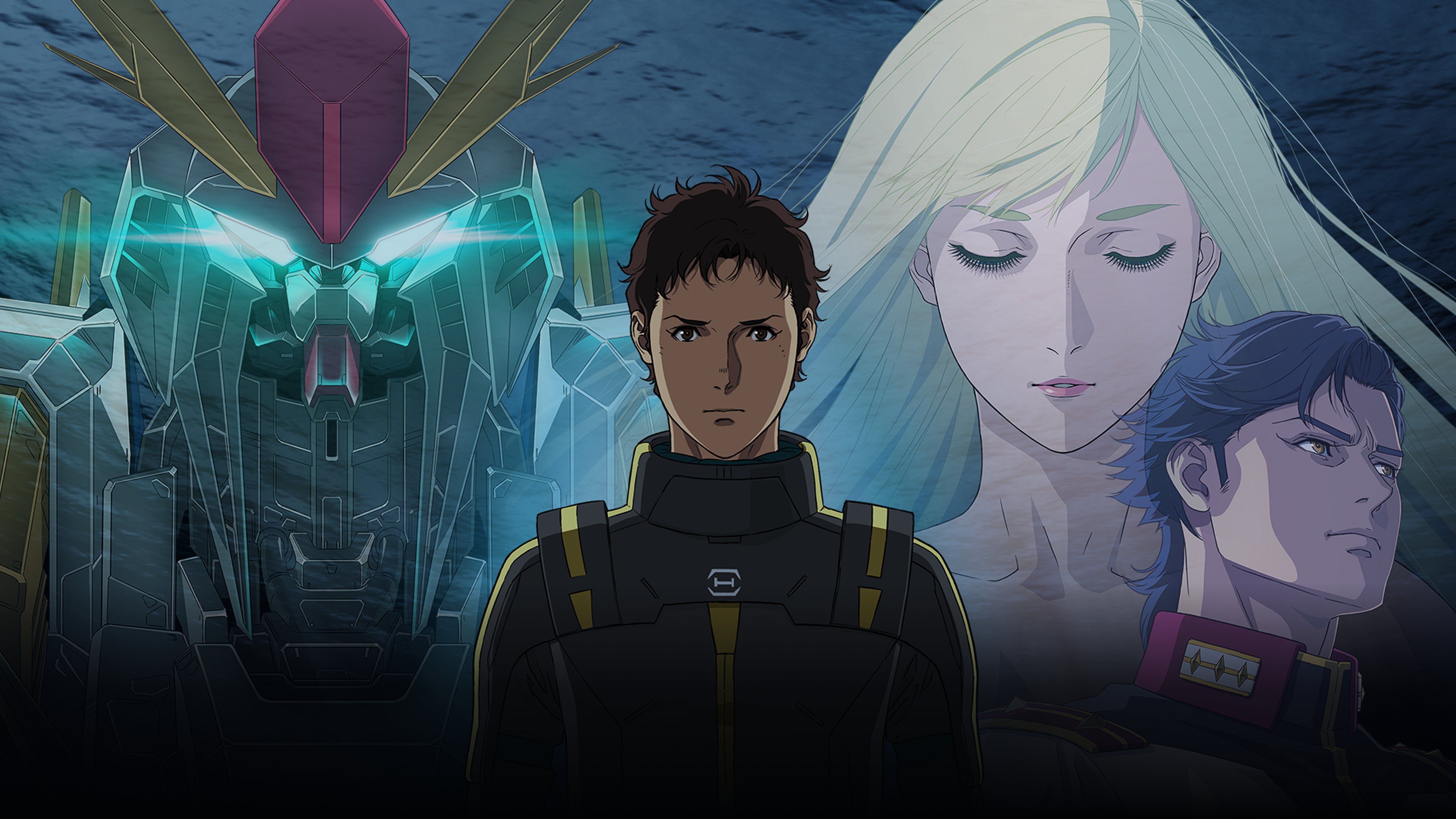
This unit is a hastily constructed trainer designed to acclimate pilots to the high-speed movement of the Penelope’s Flight Form. The “TX” in its model number likely signifies ‘Trial’ (trainer), rather than “RX”, which denotes a prototype.
The core unit of this mobile suit, its very heart, is the mass-production Nu Gundam.
This unit was constructed as part of the mass-production plan for the Nu Gundam, developed at the same time. Like the prototype Nu Gundam, it utilized Psycho Frames. Its unknown capabilities and the perceived threat it posed—having prevented Char’s meteor strike—led to the cancellation of its mass production.
Additionally, the Fin Funnels were optional equipment for the mass-production Nu Gundam. They were equipped in anticipation of new Newtypes emerging, but some sources suggest the lack of pilots capable of fully utilizing the unit’s performance was another factor in the cancellation of the mass-production plan.
Only one unit of this failed mass-production Nu Gundam was ever built, and it is believed that the one piloted by Lane Aim was this very unit. Lane’s line, “I felt it,” was also quite memorable.
Rigazzi Custom – A Relentless Recurrence of Trauma
Then, another noteworthy mobile suit appeared: the Rigazzi Custom.
The Refined Gundam Zeta, commonly known as the Rigazzi, is a refined version of the Zeta Gundam. In this work, it was confirmed to have been transported from Davao. Since it was a purple-colored Rigazzi, it must be the Rigazzi Custom.
This unit doesn’t fight in the film, but its appearance is important. For Hathaway, it represents his trauma. In Char’s Counterattack, he lost his first love, Quess, and then shot and killed Amuro’s lover, Chain. This double trauma still eats away at him.
Now, Hathaway faces the Riga-Z Custom, which was Amuro’s personal machine. The production team puts a lot of pressure on Hathaway, making his job tough. In Part 3, it’ll be interesting to see how this mobile suit challenges Hathaway, along with his struggles with his father, Bright Noa, and the ghost of Amuro. All of this pushes Hathaway further into a corner.
Summary: A Unique Gundam Work Peering into the Abyss of the Mind
The second part of Mobile Suit Gundam: Hathaway’s Flash – The Nymph of Circe stands out in the Gundam series. It focuses more on dialogue and drama than on flashy battles, has a main character struggling with mental illness, and shows adult desires with raw honesty.
Overall, I think this is a great Gundam film. The Mobile Suit battles are excellent, the human drama is engaging, and it brings a new perspective. Still, I wish there had been a few short battles in the middle to help with the pacing and add some contrast.
The climactic battle scenes are first-rate, and the cockpit-view immersion reminiscent of Top Gun is a must-see. The fact that these battles are fought by terrorists on the brink of mental collapse lends the work a dark, profound depth.
This film might be tough for newcomers to Gundam, but if you watch the previous film, ‘Hathaway’s Flash’, you’ll enjoy it more. If you can, watch ‘Char’s Counterattack’ too—it will help you better understand Hathaway’s trauma.
This is a dark, heavy film that feels like looking deep into the human mind. Still, there’s a real truth about humanity in that darkness. As a Gundam film for adults, it definitely breaks new ground.