The film Wicked: The Two Witches is characterized by nearly all its songs possessing a dual structure: they are sung in a cheerful tone while concealing a terrifying dark side beneath.
The opening song, “No One Mourns the Wicked,” depicts a nation celebrating the death of one person, which is disturbing when you think about it. “Dancing Through Life” is upbeat but highlights the dangers of anti-intellectualism and peer pressure. The scene where young people throw books around the library shows how ignoring knowledge can lead to harmful ideas.
In this scene, Glinda (Ariana Grande) tries to make Elphaba popular. Ironically, it hints that Glinda herself will later become popular, but without substance.
It is precisely through music that these complex nuances coalesce into a single harmonious melody. Light and dark, love and curse, blessing and tragedy all resonate simultaneously. This is the unique power inherent in the musical art form.
This story has been reimagined through four creative adaptations, culminating in the 2024 film release.
Wicked: The Two Witches passed through four key adaptation stages before becoming this film.
- L. Frank Baum’s children’s novel The Wonderful Wizard of Oz (1900)
- Incidentally, the protagonist Elphaba’s name is derived from the author’s initials, “L.F.B.”
- The film adaptation of The Wizard of Oz (1939), starring Judy Garland
- This film adaptation cemented The Wizard of Oz as a classic of popular culture. However, the production background of this work was overshadowed by the inhumane conditions prevalent in the film industry at the time.
- Wicked: The Untold Story of the Other Two Witches of Oz (1995 Novel)
- An innovative approach retelling the story from the witch’s perspective, labeled the “villain.” In Japanese terms, it’s akin to depicting Momotaro from the ogre’s viewpoint.
- Broadway Musical ‘Wicked’ (2003)
The musical adaptation changes the novel a lot, focusing on the friendship between Elphaba and Glinda. The music is by Stephen Schwartz, and the script is by Winnie Holzman.
This film keeps the original elements—such as its unique visual style, powerful performances, and evocative music—and pushes cinematic boundaries to reach new heights. Each version has deepened and enriched the story’s central themes of redemption and resilience.
The Power of Innovation and Diversity in John M. Chu’s Musical Films
Director John M. Chu advances the genre by blending deep respect for diversity with a strong grasp of musicals, building on his acclaimed work, including In the Heights (2021).
In this film, Wicked: The Two Witches, Chu’s greatest innovation was that “the scenes where the two leads sing were filmed and recorded simultaneously.” While it’s common practice in film musicals to lip-sync to pre-recorded vocals, this production actually filmed the performances live as the actors sang.
Particularly astonishing is the climactic scene. Cynthia Erivo, playing Elphaba, sings while suspended by wires and violently swung back and forth. This shoot demanded abilities entirely different from standing on solid ground and projecting a powerful voice, yet she delivered an overwhelming vocal performance. It can only be described as literally “superhuman.”
Furthermore, the production extensively used physical sets. By avoiding excessive reliance on CG and creating spaces actors could physically touch and move within, a raw authenticity was born on set. This very intensity is what sets this film apart from other musicals.
A Universal Message Born of Diversity
Director Jon M. Chu’s signature “uncompromisingly diverse casting” works brilliantly here. The inhabitants of Oz are diverse in every way: race, ethnicity, age, gender, and disability status.
But even in this diverse world, animals are still treated as outsiders, and Elphaba, with her green skin, faces prejudice. This shows that discrimination is a universal problem.
Discrimination and prejudice aren’t limited to certain times or groups. Even in modern societies, some people are left out. Sometimes, those who are oppressed in one way can become oppressors in another. This is known as “intersectionality.”
In the story, Elphaba herself has a scene in which she calls Glinda, the blonde, a “dumb blonde.” Even within her, who has been discriminated against, unconscious stereotypes are ingrained. In this way, the work expresses human complexity in multiple layers, without reducing it to a single facet.
A Tragic Structure Enveloped in Lavish Visual Beauty
One of the saddest parts of Wicked: The Two Witches is that an act of love can end up hurting someone else. Despite this tragedy, the film is visually stunning—its bright, beautiful colors heightening the emotional contrast.
Oz is shown as a magical, glowing world. Shiz University has detailed buildings and colorful light shining through stained glass. The spinning library shelves, fancy dance hall, and the bright Emerald City all look like something out of a dream.
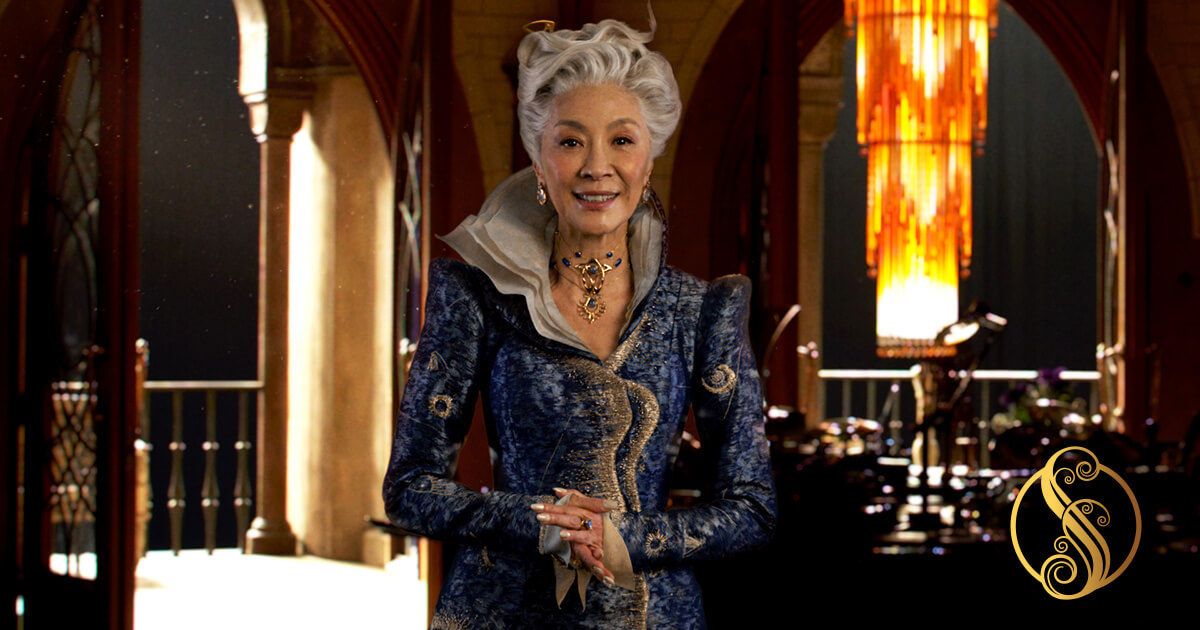
The students’ uniforms also reveal an astonishing attention to detail. While primarily blue, Shiz University uniforms feature subtle variations reflecting each individual’s personality. Every detail is meticulously designed—from collar shapes and button placements to scarf and tie knots—visually expressing each student’s character.

Glinda’s outfits really stand out. Her pink dresses look like something from a fairy tale, with lace and beads, and every ribbon and jewel is chosen to match her character. Even her classroom look—a pink cardigan, a pearl necklace, and perfect hair—shows who she is.
Elphaba’s costumes, while predominantly black, radiate a unique beauty through the contrast with her green skin. The simple yet functional designs express her earnest character. Her school uniform is blue like the other students’, but the details are adjusted to give it a somewhat subdued, plain impression.
The beauty of this world makes the story’s sadness even stronger. Even with all the bright costumes and scenery, there’s a deep loneliness underneath. This visual-emotional contrast resonates throughout the film, moving the audience.
Right before the climax, there’s a powerful moment. Glinda, in tears, watches Elphaba run away from Oz. She sees her friend shivering and gives her a black cloak. They share a laugh, even as they cry.
This is clearly an act of love and a touching moment of friendship. But at the same time, the black cloak becomes the symbol of the “Wicked Witch.” Glinda’s kindness ultimately helps create Elphaba’s new identity, a deep irony in the story.
In Part II, this structure deepens further. An action taken by one character out of intense affection for another leads to an irreversible tragedy. Love and curse are two sides of the same coin. The more beautiful, the more tragic; the more tragic, the more beautiful. This is the essence of the story, and that essence is etched even more powerfully into the heart through the lavishly gorgeous visuals.
Elphaba’s “Superpower of Song” as Portrayed by Cynthia Erivo
Cynthia Erivo’s Elphaba truly shows “superhuman” abilities in this film. She holds back her magic for most of the story, but finally lets it out in the climax.
At that moment, the audience gets to see the “superpower of song.”
Suspended by wires and violently tossed about, she continues singing with overwhelming vocal power. The final note, originally set high to match Idina Menzel’s vocal range in the Broadway version—an impossibly high note—is sung perfectly by Elivah.
Hitting this “impossible note” shows Elphaba’s true power. In this moment, the film and musical come together perfectly.
The Complex Charm of Ariana Grande’s Glinda
Ariana Grande’s Glinda turns out to be much more complex and interesting than you might expect.
On the surface, she’s the quintessential “popular princess” with blonde hair and pink accents. Yet she’s anything but a simple “good girl.” She struggles between the persona she projects to meet others’ expectations and her true self.
Glinda’s appeal comes from her charm. If a taller, model-like actress played her, she might seem annoying. But Ariana Grande’s small size and lively, funny movements make Glinda lovable.
The “Popular” scene is a highlight. The audience laughs and enjoys her cuteness as she jumps on the bed or sits stiffly on the balcony. At the same time, this scene hints that she’ll later become popular but without real influence.
The Miracle of the Final 17 Minutes – The Overwhelming Catharsis of “Defying Gravity”
Everything builds up to the “Defying Gravity” climax. In the original musical, this scene is about 5-6 minutes, but in the film, it lasts a full 17 minutes.
The Layered Meaning of Friendship and Farewell
The scene begins with the line “I hope you’re happy.” It’s Glinda’s sarcastic remark to Elphaba, who has refused Oz’s offer of power. “Are you satisfied with this?”
By the end of the scene, “I hope you’re happy” means something totally different. It becomes a sad goodbye to a close friend.
This double meaning in the lyrics is what makes musicals so special.
The Film’s Unique Use of Vertical Space
To save Glinda, Elphaba yells, “I’m the one chasing you!” and jumps out the window. This starts the film’s amazing, original sequence.
Elphaba falls headfirst. As she drops, she hears all the insults she’s faced in her life: “Green monster,” “Failure,” “Devil’s child.”
These words feel like gravity, trying to pull her down. But as she falls, Elphaba remembers her past, her sister, and her friendship with Glinda.
This look into Elphaba’s mind is something only film can show. It captures the moment she accepts herself, which isn’t possible on stage.
Then her fall becomes flight. The way the film uses vertical space lets the audience feel what it’s like to break free from gravity.
The Final Shout: The Ultimate Superpower of Song
And the faces of the overwhelmed crowd. Firework-like, dazzling visual effects. After a single beat’s pause—
Cynthia Erivo’s powerful shout echoes through the scene.
It’s amazing how she can sing so powerfully while hanging from wires. She truly shows the “superpower of song” right in front of us.
And as Elphaba takes flight, the melody of “Unlimited” overlays once more. Simultaneously, Glinda’s heartbreaking plea—“I hope you’re happy”—and the crowd’s shouts—“Catch the witch!”—resound.
Friendship and hatred, understanding and confusion, beauty and ugliness—all these feelings come together in a musical whirlwind that builds to the climax—
Bang! “To be continued in Part 2.”
At this point, everyone in the theater wants to stand up and cheer. It’s the moment when the musical and film come together perfectly, creating pure excitement.
This is truly a high point in musical film history.
Summary: A Musical Masterpiece Where Love and Curse Intersect
The film Wicked: The Two Witches was a masterpiece that polished the Broadway classic to its highest degree within the film medium.
After years of changes and four adaptations, this film finally came to life. It faces the tough history of prejudice and discrimination directly, turning it into powerful entertainment. That’s truly impressive.
Cynthia Erivo and Ariana Grande are perfectly cast. Director Jon M. Chu’s eye for visuals and respect for diversity shine through. Most of all, the emotional depth that only a musical can offer comes together beautifully.
Especially the final 17 minutes of “Defying Gravity” is a legendary scene in musical film history, one likely to be talked about for years to come. Love becomes a curse, and the curse becomes love. In that miraculous moment, the entire world—beautifully tragic and tragically beautiful—melted together as one through music.
Until Part 2 comes out, I know I’ll keep watching this scene over and over. And I bet you’ll find yourself humming “Unlimited” with tears in your eyes, too.